LABOR DAY SPECIAL: Free Chicken Wings Bonus with the Summer Grilling Box, only until Sept 8th

A Father's Belief

written by

Joe Wanda

posted on

March 7, 2026


“My father gave me the greatest gift anyone could give another person: He believed in me.” - Jim Valvano

I’m often complimented for achieving success in building Wanda Farms. 

However, just like Luke Skywalker needed Obi-Wan Kenobi and the Karate kid needed Mr Miyagi. 

I also needed a mentor. That man was my father, Tom Wanda. 

Last week, February 27th, 2026. My Dad was promoted to be home to be with the Lord. 

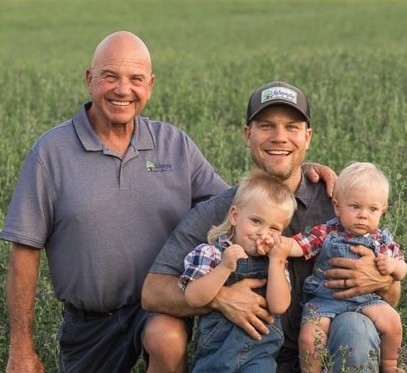
Today I’d like to share a true story giving tribute to my father for helping us start Wanda Farms. You wouldn't be enjoying that burger or those fresh eggs without this man in my life.
bd40ad4f6ebbd766936cc5b3f6c90f6c.jpeg

A Father's Belief

11 years ago after a long January winter day working at the dairy farm, I was enjoying my evening reclined in the lazy boy chair reading my favorite dairy farming magazine. Meanwhile finding myself drifting off thinking about that 77 acre farm next door to Dad’s place still for sale. 

Just then I hear my phone ring….I grab it to answer. 

Caller ID shows Dad.

I quickly answer the call and hear over the radiowaves: 

“What’s up Joe Boy!”

Dad and I always had this fun way since I was a kid of saying Joe boy and Dad boy. It didn’t really make much sense, but we had fun and I think it was our way of just saying “You are special” Or “I love you”.

I replied with some small talk 

“Not much Dad, just reading an article on 3 best practices to keep your cow’s teats clean” 

Well my Dad, very uninterested in dairy cow health, continued to tell me the reason he was calling. 

I could tell in his voice, he was excited, but also a little nervous ....

He continued.

”Well I talked to our financial advisor today. We think we could pull the funds needed out of our retirement account to help fund the purchase of the 77 acre farm next door. 

Mom and I plan to make an offer this week. 

What I need to know is, are you ready to operate this farm Joe?”

Surprised by what I just heard, the farmer joe was ready to jump out of my chair and exclaim “YES!” 

But…. 

The analytical side of my brain knew this property wouldn’t cashflow by itself and not to mention I didn’t want to risk losing my parents' life savings. 

You see this wasn’t the 1st time my dad and I talked about a possible rent to buy agreement. Over the course of the last year, I had been seeking out financing from him or a bank. We knew it would require my dad’s assistance to qualify for the purchase. 

And my dad was rightly concerned, not just because this was a large amount of his money to invest in me, but this would actually be the 2nd time of him purchasing a farm just for me. 

Let me share. 

Back when I was 8 years old. I loved farming. 

I mean I LOVED it. I’d spend lots of my time and money on purchasing toy tractors and creating these farm displays. Meanwhile helping my parents every moment I could on our hobby farm caring for the animals and especially any tractor driving! 

Screenshot-2025-03-31-at-12.33.48 PM.png

Of course when any stranger or friend would ask what I wanted to be when I grew up. It was a simple answer: 

A FARMER

My dad knew it. 

However, time and time again as a young boy I would hear things like: 

“Son, farming is too expensive to get into” 

“You can’t make a living being a farmer” 

“No, No, Its too difficult of a career, stick to your dad’s car business”

However, there was one man in my life that never told me I couldn't be a farmer.

In fact he encouraged it. 

That man was my DAD. 

So he took it on for himself to see this boy's dream happen. 

And when I was 8 years old, my dad decided to invest some of the profits from his auto business into a farm. 

He purchased this beautiful 120 acre farm in southwest Wisconsin. 

He would say time and time again. 

“Someday you can farm this Joey”

Well long story short, by the time I reached 13. My interests were much different. 

I was more concerned about how stylish my jeans or hair were, cool cars, or how to get my 1st girlfriend… ;)

My dad recognized at that moment, Joe may actually not be a farmer and the farmland values were good. So he sold the farm and thankfully made some money on his investment just before the real estate crash in 2008. 

As time continued on, I got past that weird phase of trying to figure out who I was rather quickly. By age 15 I was talking about farming again and 16 I was working for the neighbors dairy farm milking cows. And the rest was history as my farming career has continued on for 20 years now. 

So when my dad asked me at age 24, “Am I ready to commit to purchasing this farm?” This would be his 2nd time buying a farm for me. 

…But this time…He was about to retire. And I’m sure he probably had to twist his financial advisor's arm and convince my mom into the decision. 

So after giving it a quick thought through my head, the farmer Joe nervously replied to my Dad…

“Let's do it Dad boy!” 

And that was the beginning of our now successful farm business, Wanda Farms. 

a-107-(1).jpg

My Dad was an incredible man in so many ways. 

However as I reflected just before his passing, there’s one thing that stands out about his character and this story displays it. 

He believed in me, my siblings, and others in his life. 

I’ve talked to so many others that have also been touched by my Dad’s belief in them. 

Belief that God forgave them – While others didn’t want to forgive, my dad would forgive you just as Christ forgave. 

Belief that they were enough – While others only saw your weaknesses, he saw your strengths. 

Belief that their good could overcome their evil doings – While others would shame you, he made you feel accepted regardless of your shortcomings. 

Belief that they could achieve the impossible – While others were nay sayers. My Dad would say “we will find a way”. 

My Dad believed in me and he will never be forgotten in encouraging me to pursue my dreams.  

I know he was so proud of all the success our farm has achieved today. 

He was an incredible father, friend, and mentor. Mentoring me in business, relationships, and also spiritually.

Now that he has passed, I recognize the greatest gift he ever left me was his example of living his life for Christ. 

I'm comforted in knowing his testimony of accepting Christ as his savior led him home to be with the Lord for Eternity.

May He rest in peace in Eternal Glory….I love you Dad.

For by grace you have been saved through faith, and that not of yourselves; it is the gift of God, not of works, lest anyone should boast. – Ephesians 2:8-9

If you knew my father or were touched by this story and want to learn about him. He would have been honored for you to watch his funeral. 

More from the blog

"Air-chilled" chicken: another marketing gimmick?

Air-Chilled vs. Water-Chilled: The Truth About Chicken Processing, PAA, and What Really Matters As consumers become more educated about food quality, one topic has begun circulating online in the health space: air-chilled chicken. New marketing language like “air-chilled” is showing up on grocery store packaging everywhere. While the intention behind asking these questions is often good, the conversation has become oversimplified from our point of view.  At Wanda Farms, we believe transparency matters more than trends. Our chicken is water-chilled using a USDA-inspected cold water system with a peracetic acid (PAA) antimicrobial rinse. (We aren’t trying to hide anything.) However, when you keep reading, you'll learn why the air-chilled label has taken off, what actually impacts food safety and quality, and how we’re thinking about processing decisions with research instead of just chasing the latest marketing claim. Why Air-Chilled Debate Exploded The last several years, there’s been a growing push toward “air-chilled” poultry showing up at higher-end grocery stores and specialty butchers. Shoppers see the word on a package next to a premium price tag, and it’s easy to assume it means cleaner, safer, or healthier chicken.  Consumers, as they should be, are mainly concerned about how their food is processed. “Air-chilled” feels like a shortcut to less-processed, more natural chicken, especially compared to a method that involves a “chemical rinse.”  But removing water immersion from the process does not automatically create a safer or healthier bird. PAA: The First Line in Food Safety One of the most common concerns surrounding water-chilled chicken is the antimicrobial rinse itself. That concern is understandable. Nobody wants to feel like their food was doused in chemicals.  That said, here’s what’s actually true: PAA (peracetic acid) is effectively a combination of vinegar and peroxide, breaking down into acetic acid, oxygen, and water residue. It’s USDA-approved and used at tightly controlled, low concentrations. It’s USDA Certified Organic-compliant, which is why it can be used at our Certified Organic processing facility.  It’s one of the most common tools in U.S. poultry processing for reducing Salmonella and Campylobacter loads. This distinction matters far more than simply choosing air over water. Understanding what PAA actually is, and why it’s there, eliminates a lot of the chemical and environmental concern consumers associate with the word “rinse,” while still allowing our processor to meet strict food safety standards. (FYI: we only use USDA-inspected processors, always.) The Real Issue: Air-Chilled ≠ Automatically Safer Much of the air-chilled preference stems from a legitimate texture and quality discussion, not necessarily a food safety one. What Air Chilling Actually Changes Air-chilled birds are cooled with circulating cold air instead of being submerged in a communal chill tank. This typically means:  Less retained water, so less purge in the packageBetter browning and skin crisping when cookedLess cross-bird contact during chilling All legitimate, real differences. Air-Chilled Is Not the Enemy: The Framing Is. There’s a growing misconception online that air-chilled is inherently “cleaner” or “safer,” and that water-chilled means “contaminated.” That’s not supported by the facts. Air-chilled birds still receive an antimicrobial intervention, typically a cold mist spray that includes an antimicrobial, and many air-chill plants also use PAA earlier in the process, before the chill step.  Federal regulation doesn’t explicitly require an antimicrobial rinse, but it does require Salmonella testing, and to our processor’s knowledge, an antimicrobial step is effectively the only way to reliably pass that testing.  In a report on poultry processing*, Encyclopedia Britannica also notes an important nuance about water immersion chilling: while it can create cross-contact opportunities between birds, the combination of the wash effect plus the antimicrobial treatment can actually reduce total bacterial load across the batch.  The real question isn’t “air vs. water.” It’s whether the processor’s food safety program is doing its job. And both methods, done correctly, can be effective. *Link to report by Encyclopedia Britannica Why We Haven’t Switched to Air-Chilled We understand why customers are asking these deeper questions. We’ve been asking them too. Here’s where we’ve landed, and why: We aren’t the processor. Wanda Farms doesn’t control chilling method—our USDA-inspected processing partner does. To this day, I don’t know of any poultry processors in the Midwest that offer air chilling. If one did, we’d absolutely consider switching, but it’s not currently on the table.Water alone, without an antimicrobial, would concern me more. Chilling in plain water without PAA would hold bacteria rather than reduce it. The antimicrobial rinse is required by our USDA facility specifically to reduce the Salmonella load present on the bird.Air-chilled isn’t automatically “chemical-free” either. As noted above, most air-chill operations still apply an antimicrobial at some point in the process. It’s just applied differently.Sourcing and scale. Air-chilling requires more space, more energy, and reduces processor yield due to moisture loss, which is part of why it’s harder to find at the scale a small Midwest farm like ours needs. Where We Focus Instead Rather than chasing a chilling-method label, we put our energy into the things we believe actually move the needle on quality and integrity: Raising chickens on pastureRotational grazing practicesNon-GMO feedNo antibiotics or added hormonesHumane, low-stress handlingNutrient-dense food raised with integrity Our processor uses the PAA water-chill method because, alongside meeting food safety standards, they’ve found it helps maintain the flavor, juiciness, and texture our customers consistently tell us they love. Your Farmer’s Final Thoughts I think this air-chilled vs. water-chilled conversation is a lot like the no-corn, no-soy conversation we wrote about. A real concern, with some real substance to it, that’s gotten oversimplified into a single word on a package standing in for “better.” Salmonella occurs naturally in chickens and doesn’t affect them the way it affects us. It’s a human food-safety concern, not an animal-welfare one, and it’s why processors, air-chilled or water-chilled, treat for it. Properly cooked, handled without cross-contamination in your kitchen, it’s a non-issue either way.  I don’t want to chase a marketing label just to capture market share. I’d rather be straight with you about how our chicken is actually processed, why, and keep our focus on the parts of the process we do control: how the birds are raised. Pasture access, rotational grazing, non-GMO feed, humane handling, and nutrient-dense food raised with integrity. That’s the standard we hold ourselves to at Wanda Farms. We’re always happy to be transparent about our process and answer any other questions you may have. Hope this helps.

No Corn, No Soy: What's the buzz?

New marketing labels like “no corn, no soy” are show up. What's the big deal and should you care? We dive into full transparency and education on the subject matter and where we, Wanda Farms stand.